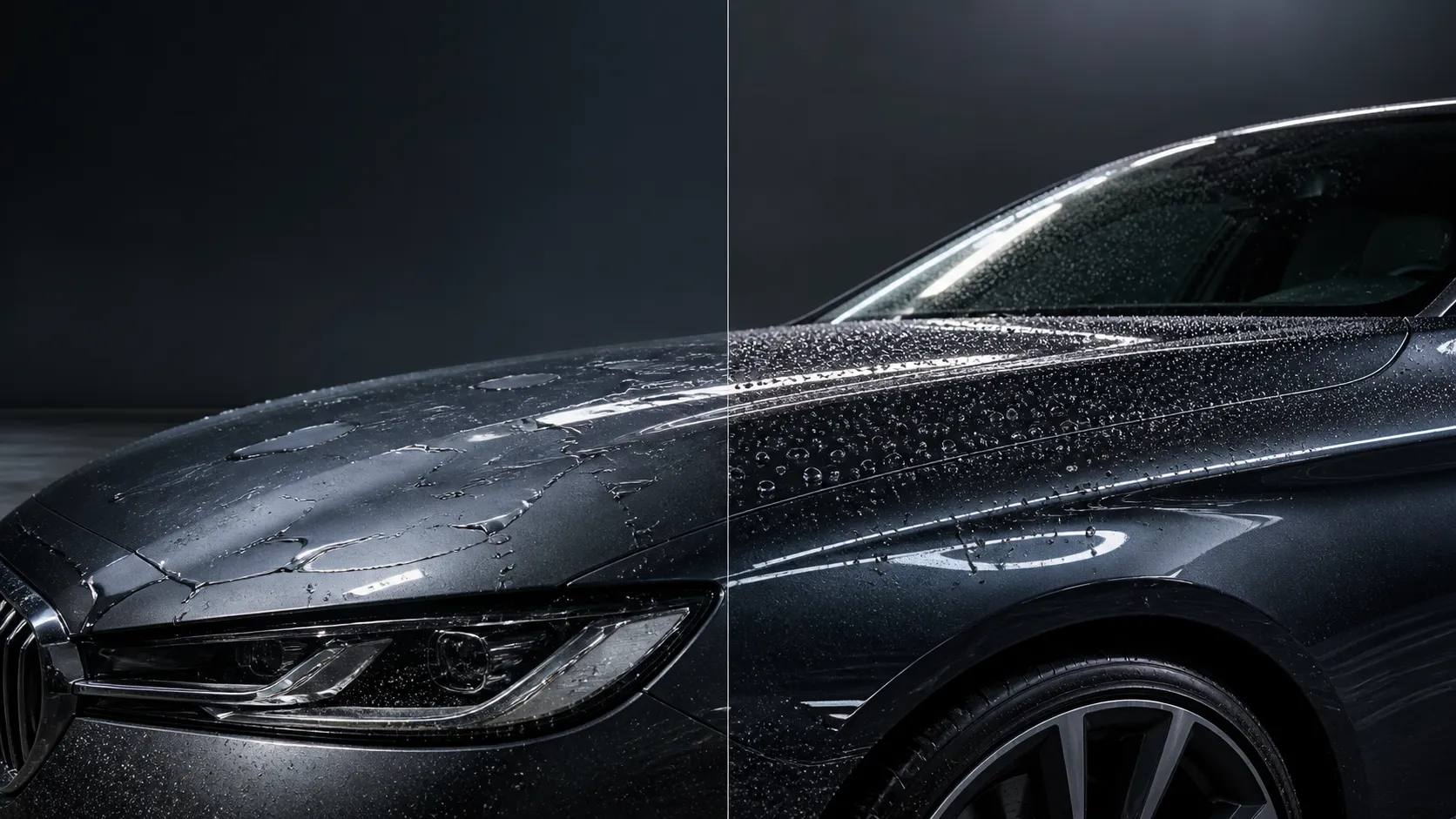
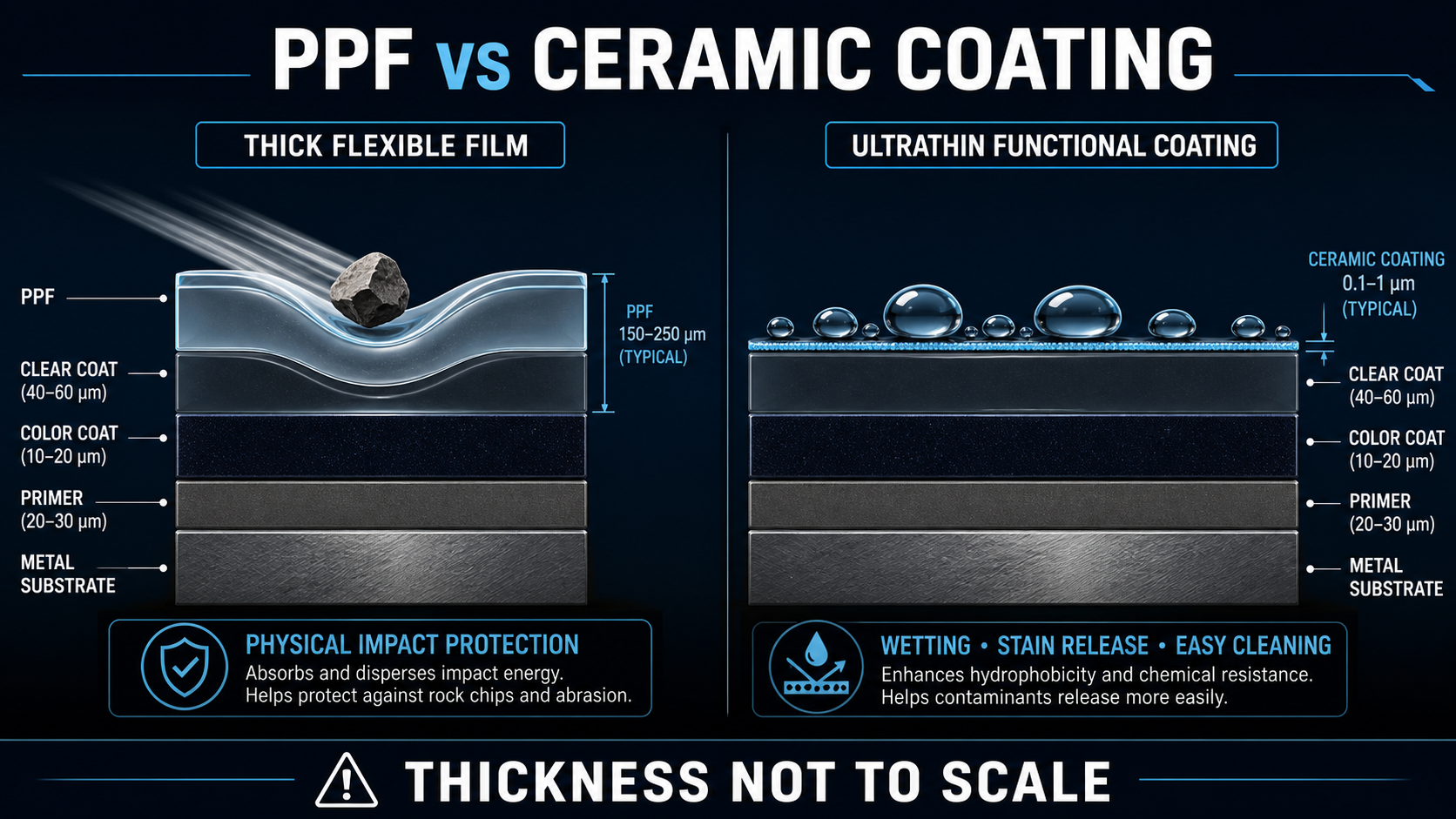
Here is the short version: ceramic coating does not wrap your car in crystal. It cures into a very thin, silicon-containing functional layer on top of the clear coat. Its real strengths are gloss, easier cleaning, reduced contaminant adhesion, and some added chemical resistance. It is not designed to stop rock chips, key scratches, or impacts.
If a detailer promises “9H armor” and years of maintenance-free paint, pause before paying.
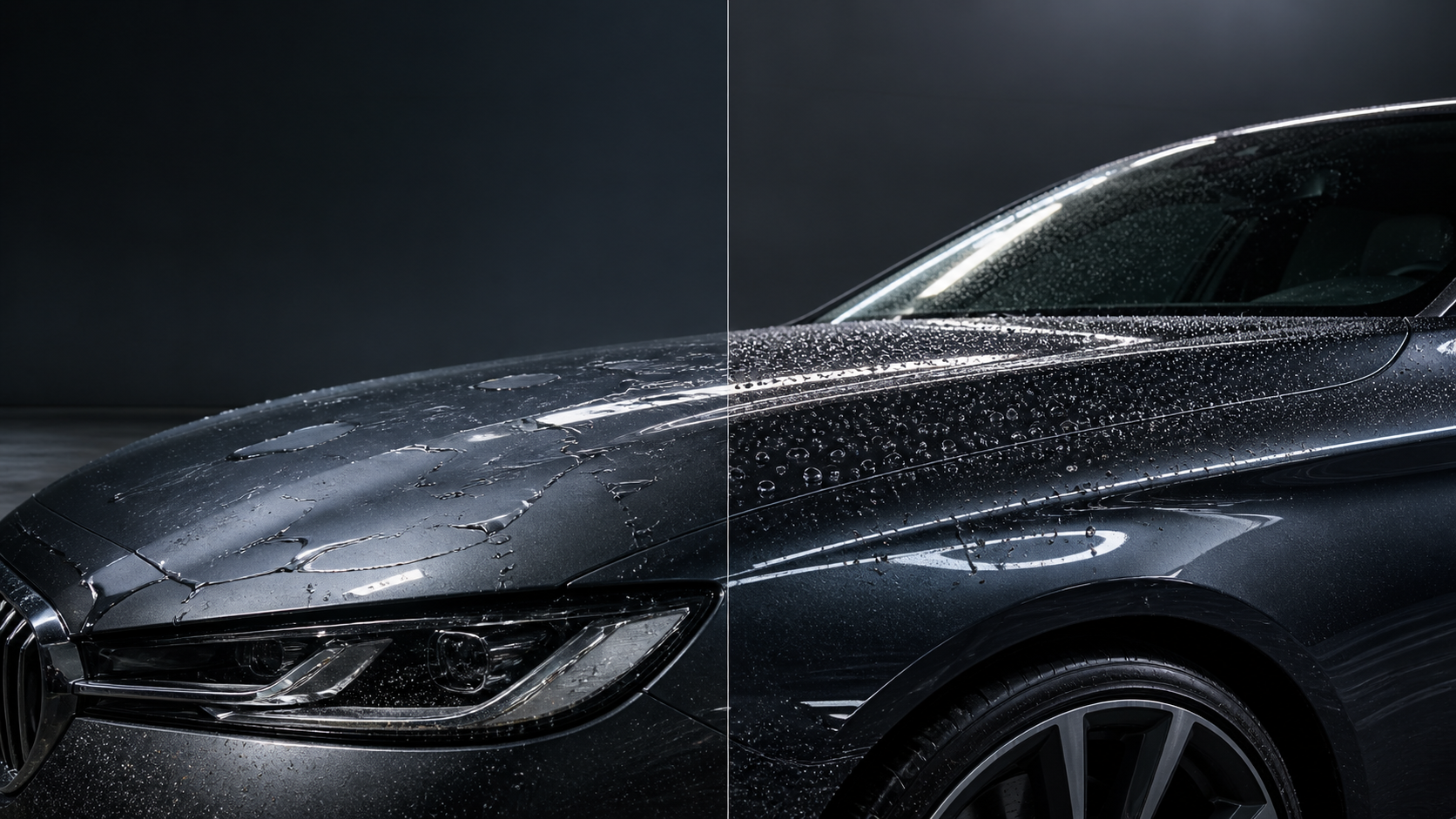
Ceramic coating in one minute
| What you want | Can it help? | The more accurate answer |
|---|---|---|
| More gloss | Yes | A uniform coating can improve slickness and visual clarity, but cleaning and paint correction create much of the dramatic finish. |
| Water beading and easier washing | Yes | Water and some contamination release more easily, but the car still needs washing. |
| Resistance to bird droppings, bugs, sap, and road salt | Somewhat | It adds a buffer and sacrificial layer, not unlimited immunity. |
| Fewer wash marks | To a degree | A lower-friction surface may reduce light marring when washed correctly. Grit and automatic brushes can still scratch it. |
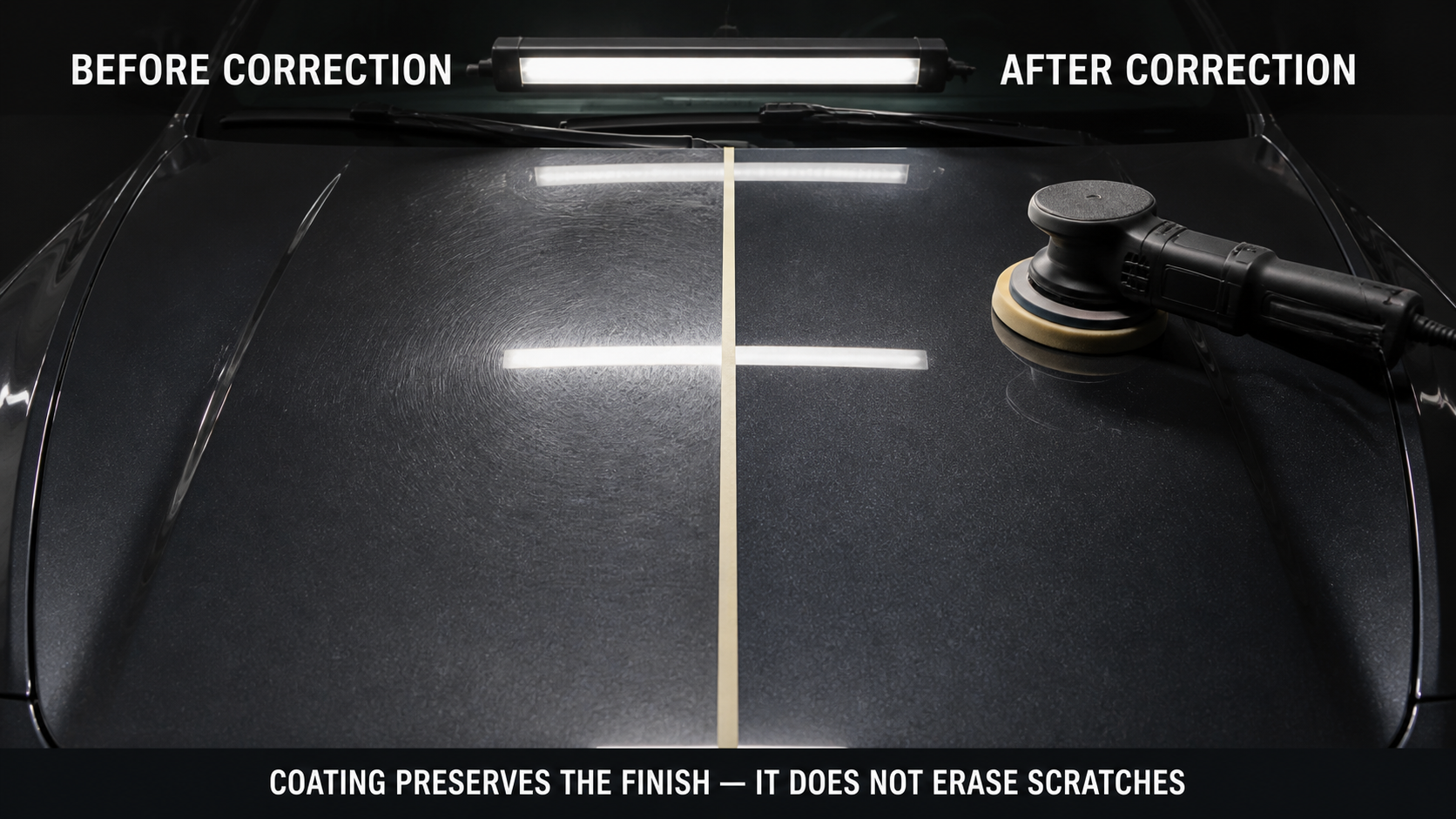
| Hide existing scratches | No | The coating is transparent and thin. Correct defects before application. |
| Stop rock chips, keys, and door impacts | No | Paint protection film is built for physical protection. |
| Never wash the car again | No | “Self-cleaning” means easier to clean, not automatically clean. |
What is actually being coated?
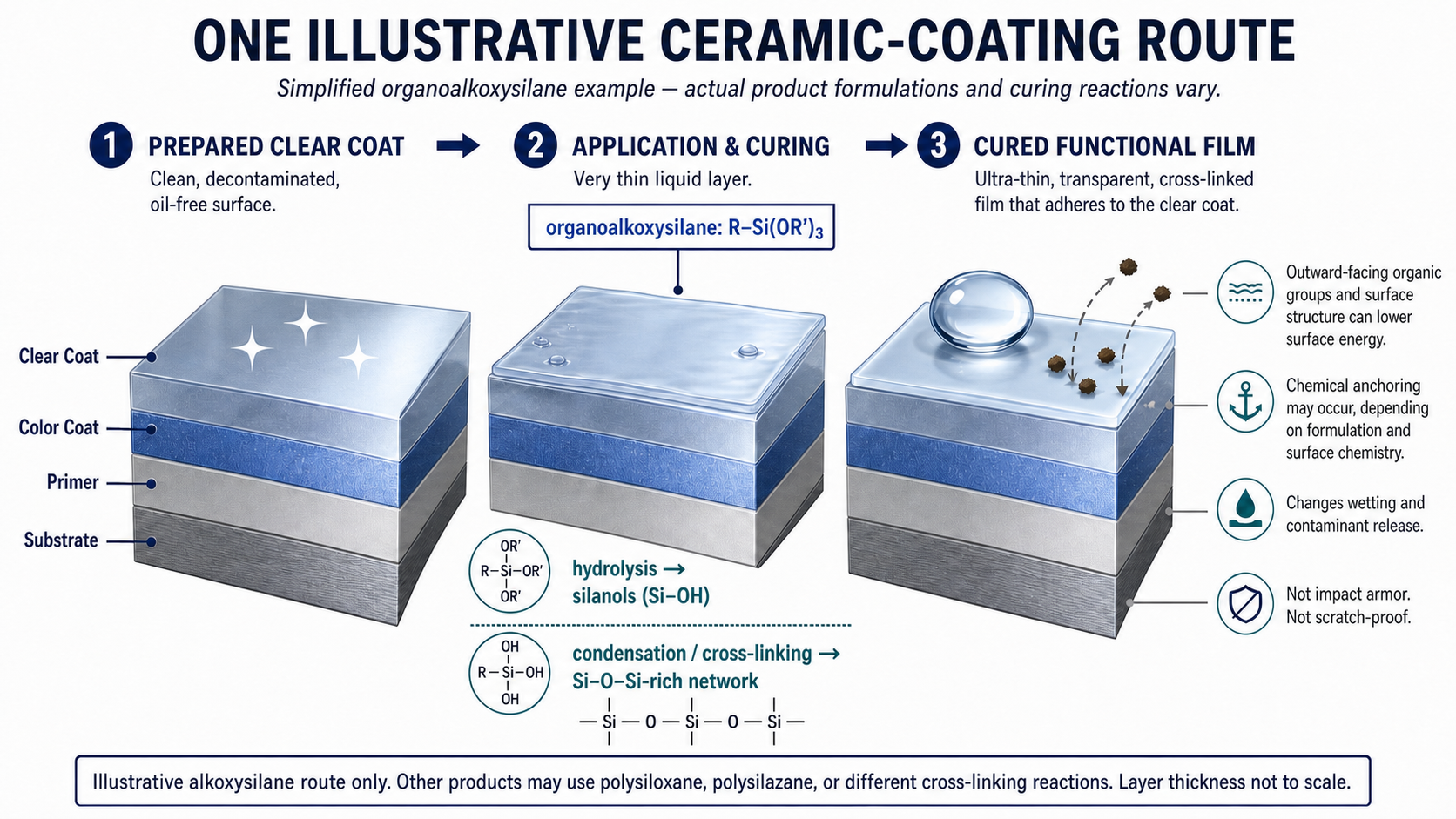
Automotive paint can be simplified into substrate, primer, color coat, and clear coat. The clear coat is the outer surface that we see and touch—the layer that develops swirls, etching, and water spots. Ceramic coating sits on top of it.
This is not electroplating, and no one is melting quartz onto the vehicle. Ceramic coating, glass coating, quartz coating, and SiO₂ coating are broad market labels. Real formulas may use alkoxysilanes, polysiloxanes, polysilazanes, other organosilicon precursors, resins, catalysts, solvents, and additives. It is inaccurate to reduce every product to “liquid silica.” Reviews of silicon-based automotive coatings describe several distinct chemical routes.[1][2]
How liquid becomes a film
Using one common alkoxysilane route as a simplified example, the process has three broad stages:
- Application and wetting. A low-viscosity liquid spreads over washed, decontaminated, and properly prepared clear coat.
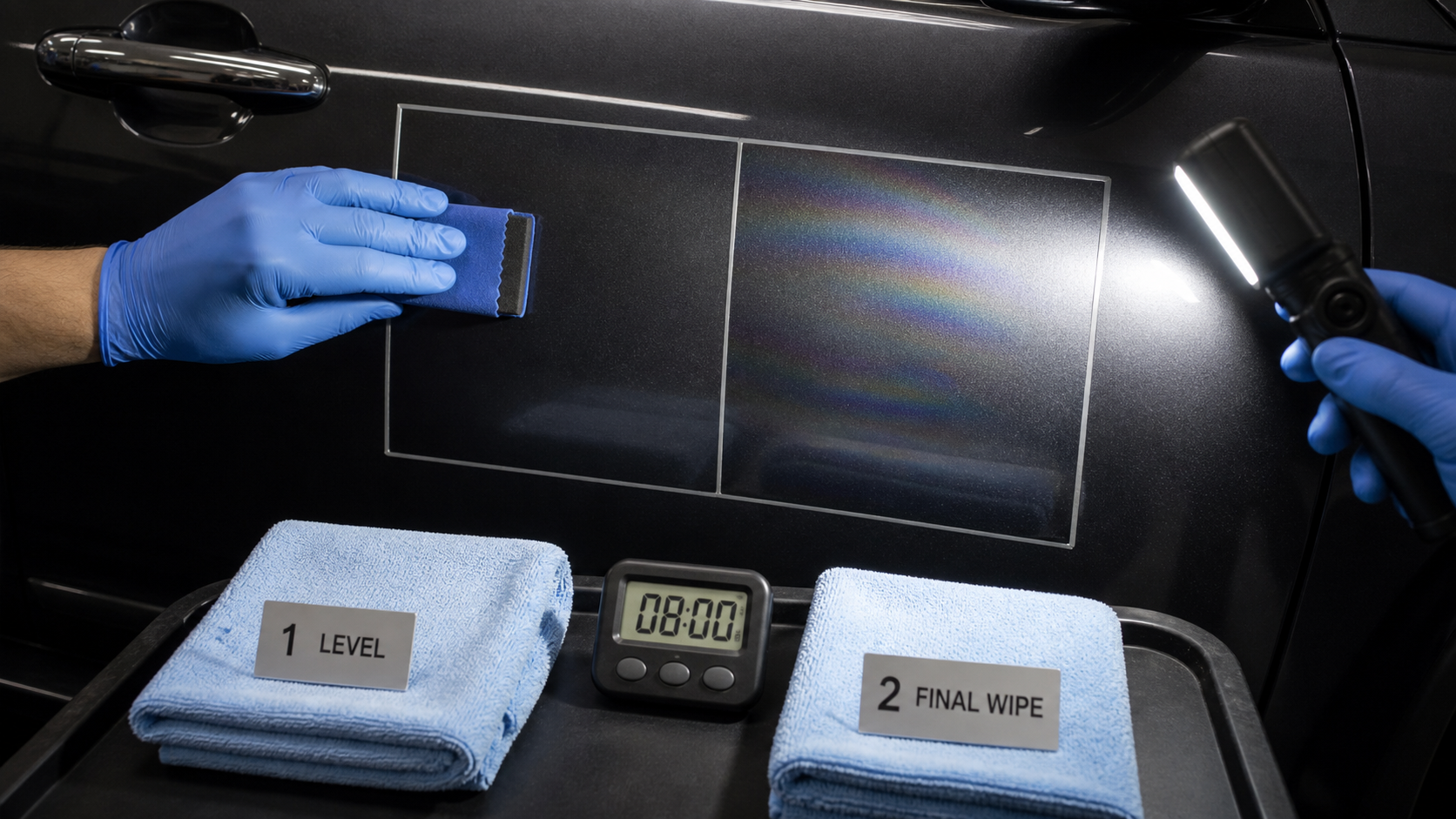
- Flash. Solvent begins to leave. Depending on the product, the film may appear to sweat, rainbow, or form tiny beads. Excess material must be leveled inside the stated working window.
- Cross-linking and cure. Reactive silicon-containing precursors undergo hydrolysis, condensation, or other cross-linking reactions, forming a transparent network attached to the surface. Whether chemical anchoring occurs depends on the formula and surface chemistry.[2][3]
Hydrolysis
R–Si(OR')₃ + 3H₂O  →  R–Si(OH)₃ + 3R'OH

Condensation / cross-linking
≡Si–OH + HO–Si≡  →  ≡Si–O–Si≡ + H₂O
This is a teaching model, not the complete recipe for a commercial bottle.
Why does it repel water?
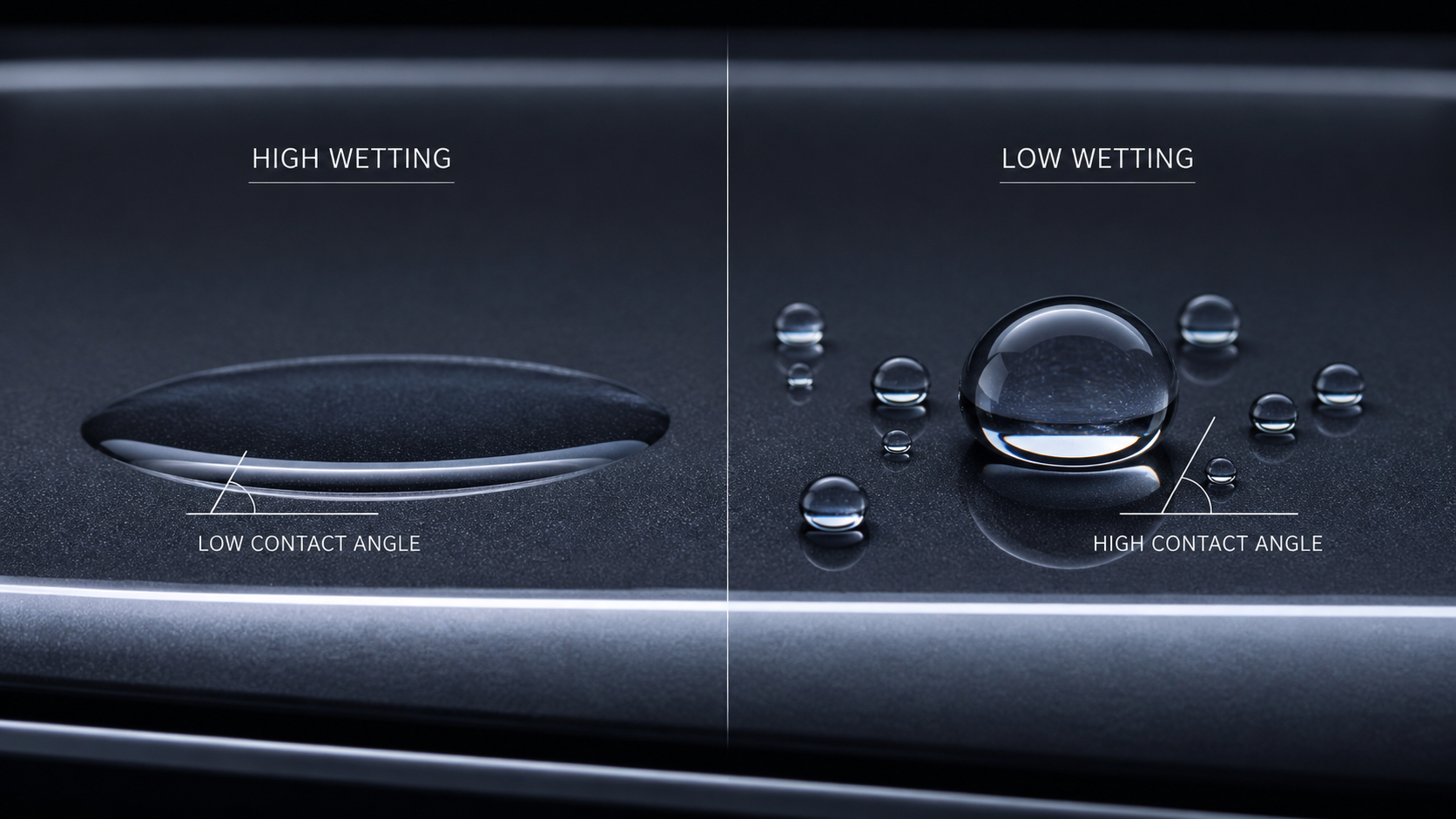
Bare, unmodified silica is not automatically hydrophobic. Silanol groups can make a silica surface hydrophilic. A commercial coating’s water behavior usually comes from lower-surface-energy organic groups—such as methyl, alkyl, fluorinated groups, or silicone chains—combined with surface structure and the cured network.[4]
That is why “more SiO₂ means rounder beads and a better product” is not a universal scientific rule. Drainage also depends on contact-angle hysteresis, roll-off angle, contamination, and mineral buildup.
What changes after coating—and for how long?
Deeper gloss and a slicker feel
A transparent film can change reflection and touch, especially on dark paint. It cannot level a scratch. Iron removal, tar removal, claying, and polishing before coating usually create most of the mirror-like transformation. Think of coating as preserving a prepared finish, not repairing a neglected one.
Different wetting and easier soil release
A low-energy surface changes how water and some contamination wet and release. Rain, mud, bug residue, and traffic film often become easier to remove. “Easier” is the key word. Dust still lands, oily film still forms, and bird droppings or tree sap still need prompt attention.
A chemical buffer and sacrificial layer
A dense cured film can delay direct exposure of clear coat to acid rain, bird droppings, insects, road salt, and cleaners. It delays attack; it does not provide endless immunity. Concentration, heat, and dwell time still matter. Coating-care guidance continues to call for prompt removal of droppings, sap, and mineral spots.[5]
Some help with fine wash marring—not armor
Gtechniq, for example, describes its coating as roughly 1 μm thick and PPF as roughly 150 μm. Those figures should not be applied to every brand or test method, but they show why the two products have different jobs. A coating can change friction and chemical response; it does not have enough bulk to absorb a highway-speed stone.[5]
How long does it last?
There is no industry-wide answer. Even consumer products carry very different manufacturer claims:
| Product example | Published durability | Important context |
|---|---|---|
| CARPRO CQUARTZ UK 3.0 | 18–24 months | Marketed as real-world durability; application range 37–104°F / 3–40°C.[6] |
| GYEON Q² Mohs EVO | Up to 36 months / 25,000 miles for one layer; up to 48 months / 31,000 miles for two | About 15–25 ml per car; one layer can be used alone.[7] |
| Gtechniq Crystal Serum Light | Up to 5 years | The company says driving, exposure, and washing habits affect life.[8] |
These are manufacturer claims, not an independent head-to-head test. Real service life depends on preparation, leveling, early cure conditions, indoor or outdoor parking, mileage, road salt, hard water, contamination, washing frequency, and tools.
One counterintuitive point: weaker beading does not necessarily mean the base coating is gone. Traffic film and mineral deposits can mask its surface behavior. Clean and decontaminate with coating-compatible products before deciding to start over.
How to choose a ceramic coating
Identify the product class first
- Spray on and wipe off with little cure control: usually a spray sealant or maintenance product. It can leave a functional film, but its solids, cross-linking, and durability usually differ from a long-life wipe-on coating.
- Requires stripping, panel preparation, small-section application, timed leveling, and a dry cure: a more typical consumer ceramic coating.
- Sold only through accredited installers: a professional system with stricter environmental and process requirements—and usually higher rework cost.
For a first attempt, prioritize a forgiving wipe window, complete instructions, one-layer performance, and repairability over the fastest cure or biggest hardness number.
Buy documentation, not just a bottle
A credible candidate should publish a current technical data sheet, application guide, and safety data sheet; compatible and excluded materials; temperature and humidity limits; flash cues and wipe window; layer timing; water-avoidance and cure instructions; storage life; and the conditions attached to durability or warranty claims.
For example, Gtechniq CSL specifies 41–77°F / 5–25°C, no direct sun, and at least 12 hours indoors after application, while CQUARTZ UK 3.0 publishes a much wider temperature range.[6][8] There is no universal internet-approved application temperature.
Ask what the numbers actually measure
| Marketing claim | What to ask |
|---|---|
| “9H / 10H / 12H” | Which standard, substrate, film thickness, and cure conditions? Scratch or gouge failure? |
| “pH 1–14 resistance” | Which chemical, concentration, temperature, dwell time, and pass/fail method? |
| “Superhydrophobic” | What contact angle, roll-off angle, and hysteresis? What remains after aging? |
| “UV protection” | Is the coating merely UV-stable, or did it measurably block UV? Was xenon aging used? |
| “High SiO₂ content” | Percentage of the whole bottle, nonvolatile solids, or cured residue? Are brands using the same method? |
| “Lifetime warranty” | Are annual inspections required? Are spots, scratches, reduced beading, repainting, and incorrect washing excluded? |
What “9H” means
When a manufacturer cites ASTM D3363 or ISO 15184, 9H refers to a pencil-hardness grade. Pencils of increasing hardness are pushed across a coated system under specified conditions. For an ultrathin layer, the result is a response of the coating, clear coat, and substrate together—not the bulk hardness of a free-standing ceramic slab.
ASTM notes that pencil manufacturer and batch can change results. ISO warns that the quick test is not suitable for comparing different coating types and is better used for relative evaluation under consistent conditions.[9] Pencil 9H is not Mohs 9, sapphire-like hardness, key resistance, or rock-chip protection.
If a shop will do the work
Ask the quote to separate washing, chemical and mechanical decontamination, paint correction steps, exact coating and batch, number of layers, covered surfaces, environmental controls, warranty scope, annual inspection fees, and required maintenance products. Most of the bill pays for preparation, correction, lighting, inspection, and labor—not the few ounces of liquid.
Wax, sealant, ceramic coating, or PPF?
| Option | What it is | Main advantage | Main limitation | Best fit |
|---|---|---|---|---|
| Wax | Short-lived sacrificial layer | Inexpensive, simple, warm gloss | Frequent renewal, limited chemical durability | Owners who enjoy regular maintenance |
| Synthetic sealant / ceramic spray | Polymer or silicone-based short-to-medium protection | Easy application and good beading | Usually different solids, cure, and durability from wipe-on coatings | Low-barrier hydrophobic protection |
| Ceramic coating | Transparent functional film cross-linked on clear coat | Gloss, water behavior, easier cleaning, longer life | Demanding preparation; rework often needs polishing; no chip protection | Owners who value appearance and easier maintenance |
| Paint protection film | A substantial clear polyurethane film | Better protection from stones, grit, and minor impacts | Expensive; film and installation quality matter; it also ages | Highway use and owners most concerned about chips |
A beginner’s DIY guide
Ceramic coating is not mechanically complicated, but it is unforgiving about preparation, lighting, and timing. A missed smear can cure into a high spot that requires polishing.
Decide whether DIY is sensible
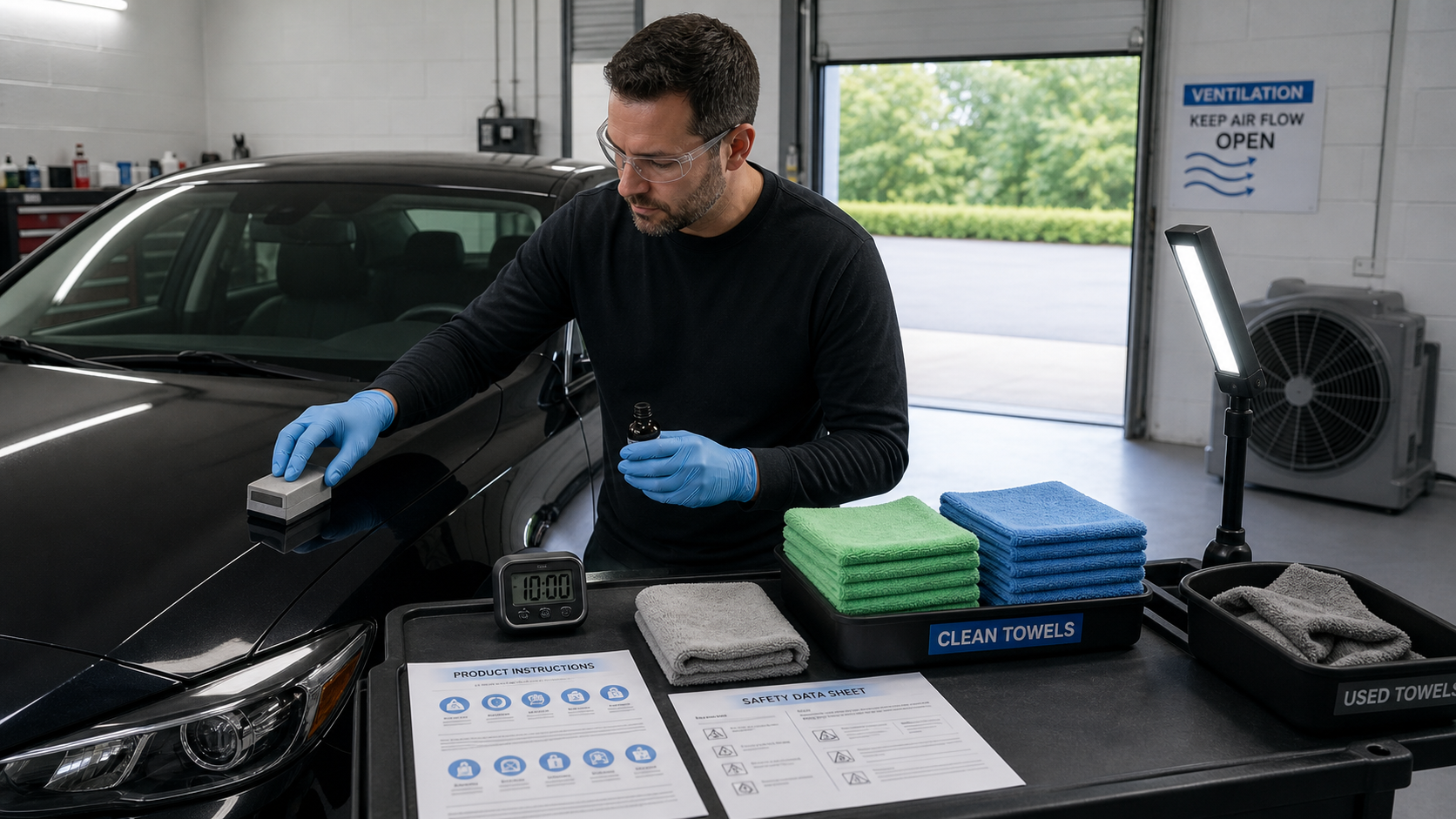
Do not open the bottle if you lack a shaded, ventilated, low-dust space that can stay dry; rain or dew is likely during the required cure; you cannot see smears on dark paint; the car needs major correction or wet sanding; the finish is matte and you planned to polish it like gloss paint; or you cannot obtain and follow the SDS.
New paint is not necessarily perfect. Transport, protective-film removal, and dealer washing can leave contamination and swirls. Inspect first; do not remove clear coat merely to make the process feel complete.
What to prepare
Cleaning and decontamination: prewash, pH-neutral shampoo, manufacturer-approved stripping or prep wash, two buckets with grit guards, clean mitt, iron remover, tar remover, clay only when necessary, compatible lubricant, drying towels or blower.
Correction and application: strong inspection lighting; polisher, pads, and compound only if you are competent; manufacturer-specified panel wipe; applicator block; plenty of clean, task-separated microfiber towels; masking tape for incompatible trim and gaps.
Personal protection: nitrile gloves, eye protection, good ventilation, any respiratory protection required by the SDS, and distance from children, pets, sparks, heat, and flames.
CSL’s U.S. SDS, for example, classifies the product as flammable, calls for gloves and eye protection, and warns of severe aspiration hazard if swallowed.[10] A dust mask is not an automatic substitute for vapor protection required by an SDS.
The 12-step application sequence
- Prewash. Rinse or prewash away loose grit before touching the paint.
- Contact wash. Work top to bottom with a clean mitt; keep wheel tools separate.
- Decontaminate. Use iron, tar, bug, or sap remover separately and rinse thoroughly between chemicals. Clay only if bonded contamination remains.
- Dry every crevice. Blow water from mirrors, handles, badges, trim, and seams.
- Inspect and correct. Remove only defects that can be corrected safely. A fingernail-catching scratch usually is not a cue to keep grinding away clear coat.
- Panel-wipe correctly. Remove polishing oils and fingerprints with the coating maker’s specified product. Do not assume one wipe removes every old wax, sealant, or coating.
- Test a hidden area. Confirm flash speed, wiping feel, and compatibility before committing to a visible panel.
- Work small sections. Overlapping crosshatch passes around 16–24 inches / 40–60 cm square are a useful beginner rhythm unless the manual says otherwise. More liquid does not equal more protection.
- Read the product, not just a stopwatch. Some coatings rainbow, sweat, or bead; current CSL instructions call for immediate removal. Temperature, humidity, color, and formula change the window.[8]
- Level with two towels and inspect in side light. Use one towel for the bulk residue and another clean towel for the final wipe. Turn and replace them often.
- Add layers only as specified. One layer may be enough. Interlayer timing, maximum layers, and compatible top coats are system-specific; life does not multiply with layer count.
- Begin the dry cure immediately. Close the bottle, record date, batch, panels, and layers, and keep the vehicle in the required environment. Retire hardened towels and dispose of materials according to the SDS, manufacturer, and local rules.
High spots, smears, and rainbow patches
A high spot is excess product that cured before it was leveled.
- Still inside the rework window: some products permit re-wetting with a little fresh coating and immediate leveling. Check the manual.
- Partially cured: do not improvise with harsh solvent or an abrasive sponge. Ask the manufacturer.
- Fully cured: the usual fix is light polishing, cleaning, preparation, and recoating the whole affected panel. Adding another layer generally traps the defect.
If unexpected rain hits a fresh coating, move the car dry, prevent droplets from air-drying, and follow the maker’s early-care process. Do not attack it immediately with strong cleaner.
Cure time is not one number
| Stage | What is happening | What you should do |
|---|---|---|
| Flash / removal window | Solvent leaves and film formation begins | Level within the product-specific window—seconds to minutes. |
| Initial set / water-avoidance period | A film remains, but water, dew, dust, and touch can still disrupt it | Keep it dry for the stated hours. “Driveable” does not automatically mean “washable.” |
| First gentle wash | The coating can tolerate normal water and careful contact | Follow the exact manual; do not infer this from water-avoidance time. |
| Full cure / strong-chemical restriction | Cross-linking, hardness, and chemical resistance continue developing | Check separate timing for strong cleaners, boosters, and top coats. |
CSL calls for at least 12 dry indoor hours. GYEON’s EVO manual also requires 12 hours without water and advises avoiding strong cleaners for 14 days.[7][8] That 14-day limit is not a universal first-wash rule.
Before starting, write down three separate deadlines: minimum dry time, first gentle wash, and when strong chemicals or maintenance toppers are allowed.
How to maintain the coating
The point is not maintenance-free paint; it is easier maintenance with less avoidable friction.
During early cure
- Keep the vehicle dry for the stated period; do not cover it with a damp car cover.
- Treat accidental water, insects, or droppings using the maker’s early-care method; never dry-wipe.
- Follow the manual for the first wash and avoid strong acid, alkali, wax stripper, or unknown tunnel chemicals.
- Do not repeatedly touch the paint just because it feels slick.
Routine washing
- Wash when dirty rather than worshiping a fixed interval.
- Pre-rinse thoroughly before contact.
- Use a pH-neutral, residue-free shampoo listed as coating-compatible.
- Wash top to bottom with separate tools for wheels and lower sections.
- Avoid brush automatic washes.
- Work on cool paint out of direct sun, then blow or gently towel-dry promptly.
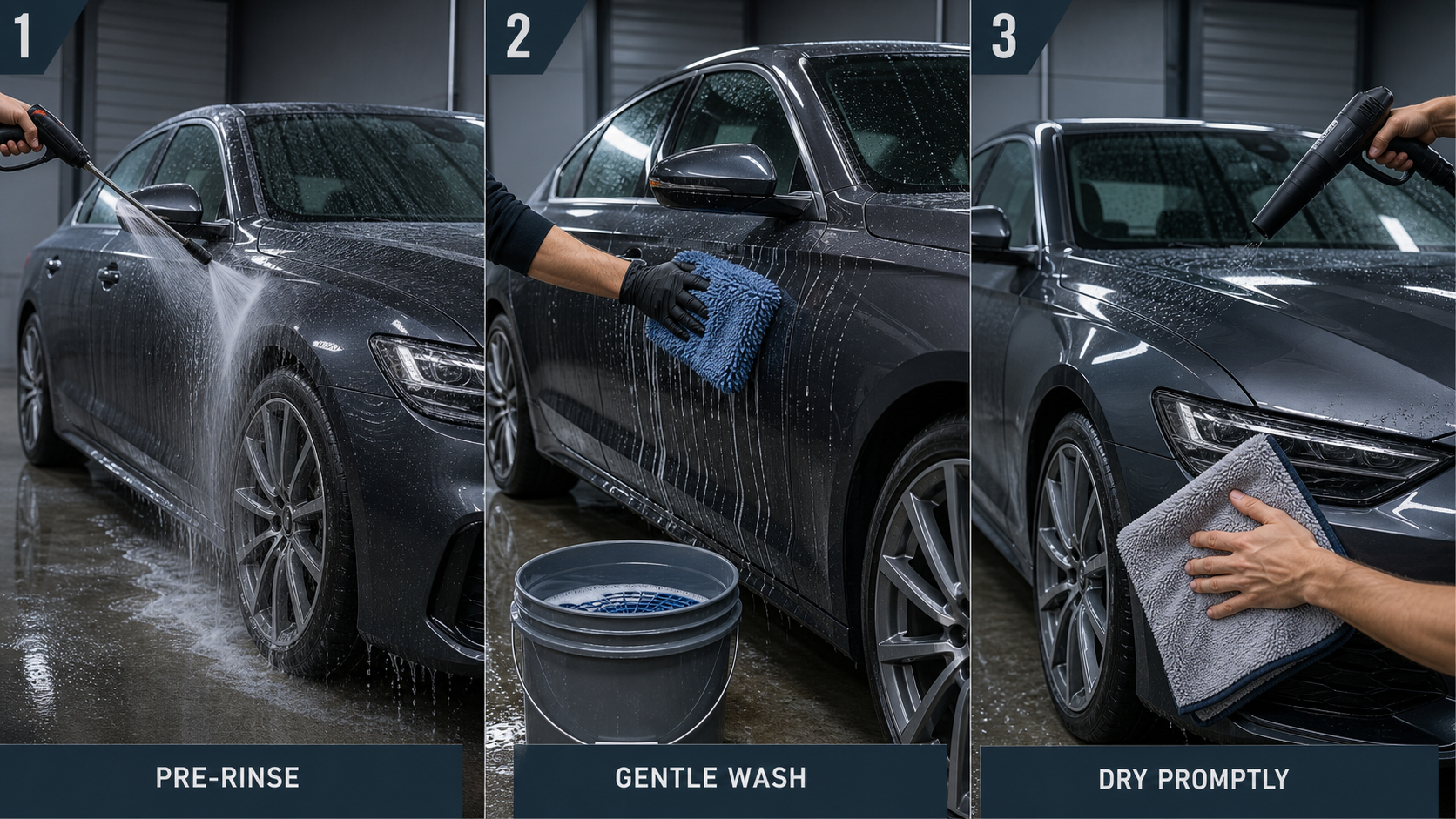
Droppings, sap, bugs, and water spots
Act early, soften first, and minimize friction. Use a compatible cleaner or damp microfiber to soften residue before lifting it away. Never pick it with a fingernail or scrub with dry paper.
Hydrophobic paint can still spot. As hard water evaporates, calcium and magnesium remain where droplets sat. Avoid hot panels and dry quickly; use softened or deionized final-rinse water when practical. Start existing spots with a coating-compatible mineral remover, not immediate abrasion.
Boosters, decontamination, and inspection
- If beading fades, rule out traffic film and mineral masking before declaring failure.
- Use only compatible toppers or boosters. Wax may not destroy a coating, but it can mask its behavior or affect warranty terms.
- Remove iron, tar, and minerals as contamination demands; do not clay routinely.
- Polishing removes coating along with clear coat. Plan to recoat a corrected panel.
- Keep receipts, batch details, and maintenance records if warranty coverage matters.
Fourteen common questions
1. Does a new car need polishing first?
Not automatically. Inspect it under strong light. If the paint is clean and defect-free, decontamination and preparation may be enough.
2. Can coating fill light scratches?
Not reliably. It is transparent and thin. Correct scratches before coating; deep defects may require paint repair.
3. Does a coated car still need washing?
Yes. Dirt releases more easily, but traffic film can accumulate and mask water behavior.
4. Will it stop rock chips or a key?
No. Choose PPF for physical impact. A staged key demonstration does not represent repeated real-world loads and angles.
5. Do rounder beads mean stronger protection?
Not necessarily. Roll-off, chemical resistance, adhesion, aging, and contamination matter too. Beads cannot tell you remaining film thickness.
6. Why can coated paint still develop water spots?
Hydrophobic water still contains minerals. When it evaporates, residue remains. Prompt drying matters more than chasing the roundest bead.
7. Can I wax over it?
Only when the system allows it. Wax can temporarily mask the coating’s feel and drainage; a matched maintenance product is more predictable.
8. Can the same bottle coat glass, wheels, plastic, matte paint, or PPF?
Only if the instructions list that surface. Wheels need heat tolerance, glass affects wipers and vision, matte paint cannot be polished like gloss, and PPF compatibility varies.
9. Do more layers multiply service life?
Usually not. A second layer may improve coverage or add limited durability, but exceeding the stated maximum increases cost and high-spot risk.
10. How do I know it has really failed?
Wash thoroughly and remove compatible oil film, minerals, and iron first. Consider replacement only if clean panels remain broadly poor at drainage and soil release near the expected mileage or age.
11. Is a lifetime warranty believable?
Read the exclusions. Many warranties omit chips, scratches, spots, and reduced beading and require paid annual inspections. “Lifetime” is often a contract condition, not immortal material.
12. Is ceramic coating worth it?
Often yes if you value gloss, easier cleaning, correct washing, and years of ownership. It is the wrong answer for rock chips, collision damage, or a car that will remain neglected. A dependable spray sealant is a lower-cost trial.
13. Can I coat over an old coating?
Not by default. Clean and decontaminate, identify what remains, and confirm system compatibility. Unknown, uneven, or high-spotted coatings usually need polishing and fresh preparation.
14. How soon after repainting can I coat?
There is no universal number. Paint system, bake process, temperature, and repair-shop requirements control solvent release and cure. Gtechniq’s current FAQ gives at least 72 hours for its system but still tells owners to follow the painter’s advice.[5] Confirm with the paint supplier, body shop, and coating maker.
The buying decision
Think of ceramic coating as a durable transparent surface treatment:
- Choose it for gloss, easier cleaning, and lower contaminant adhesion.
- Choose PPF for rock chips and minor physical impacts.
- Choose wax or a short-life sealant for low cost and easy DIY upkeep.
- Whatever you choose, keep washing correctly.
The most useful product information is not “9H,” “graphene,” or “ten years.” It is the stated temperature range, wipe window, water-avoidance time, SDS, test conditions, and warranty boundary. A manufacturer willing to explain limitations is more useful than one that only prints shields, diamonds, and water beads on the box.
Sources
Sources and product instructions were checked August 30, 2026. Specifications, manuals, and warranty terms can change; follow the current documents supplied with the exact product you buy.
[1] Ishikawa & Nishino, Surface Coating Technology for Automotive Body—Application of Silicon-Based Coatings—, Tribologist, 2021.
[2] Barroso et al., Polymeric and ceramic silicon-based coatings—a review, Journal of Materials Chemistry A.
[3] Bauer et al., Preparation of moisture-curable polysilazane coatings, Progress in Organic Coatings.
[4] ACS Omega, Silanization of SiO₂: surface functionalization and hydrophobicity enhancement.
[5] Gtechniq, current FAQ on thickness, chips, scratches, lost beading, and repainting; ceramic-coating care guidance.
[6] CARPRO, CQUARTZ UK 3.0; CARPRO Japan, CQUARTZ UK 3.0 application manual PDF.
[7] GYEON, Q² Mohs EVO; Paint Coatings Manual PDF.
[8] Gtechniq, Crystal Serum Light product and application instructions.
[9] ASTM International, ASTM D3363-22—Standard Test Method for Film Hardness by Pencil Test; ISO, ISO 15184:2020—Paints and varnishes—Determination of film hardness by pencil test.
[10] Gtechniq, Crystal Serum Light Safety Data Sheet, U.S. 2020 PDF. Use the current SDS supplied for your region and formulation.
Further reading: Edmunds, What Is Paint Protection Film?.